


Buy vs. Build in Commercial Insurance Claims Creating a Scalable and Frictionless Claims Processing Machine
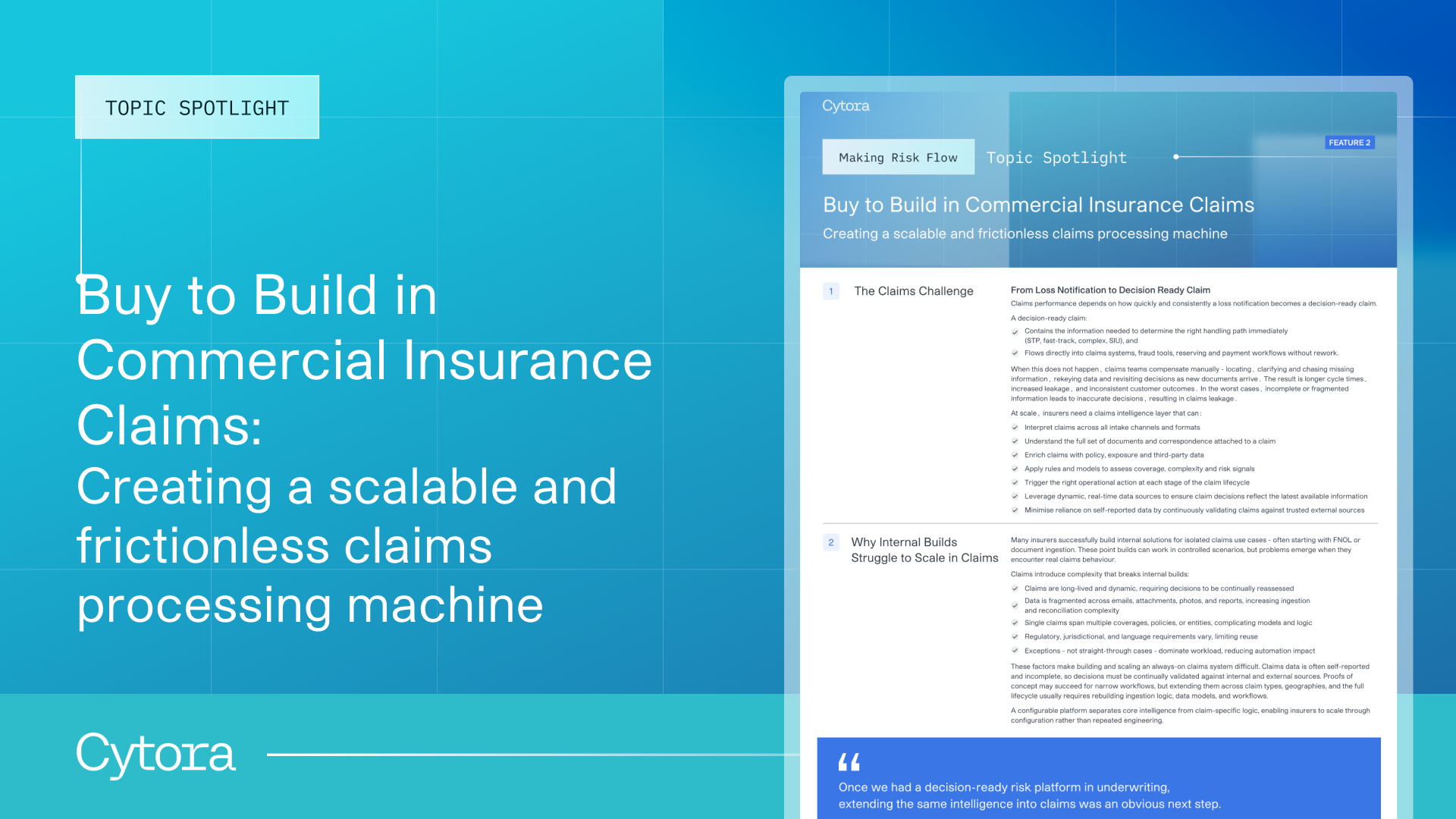
Claims performance depends on how quickly and consistently a loss notification becomes a decision-ready claim. When that doesn't happen, claims teams compensate manually — chasing missing information, rekeying data, and revisiting decisions as new documents arrive. The result: longer cycle times, increased leakage, and inconsistent customer outcomes.
This guide explores why internal builds struggle to scale in claims — and why a Buy to Build approach is emerging as the smarter path for insurers automating claims processing.
Why Internal Builds Struggle to Scale in Claims
Many insurers succeed with internal builds for isolated claims use cases like FNOL or document ingestion. But real claims behavior introduces complexity that breaks these point solutions: fragmented data across emails and attachments, claims spanning multiple coverages and policies, shifting regulatory requirements, and exception-heavy workloads that resist automation.
Claims Decisions Are Made Over Time, Not at FNOL
Optimizing FNOL alone doesn't move the needle. Claims performance depends on how decisions evolve across the full lifecycle — through progressive decision-making, human-in-the-loop review, rules- and model-driven routing, and full traceability for audit and regulatory needs.
What to Buy vs. What to Build in Claims
The recommended model is Buy to Build:
Buy — the common intelligence layer: claims ingestion and orchestration, document classification, data extraction and enrichment, and continuous AI, data, and regulatory updates.
Configure — the parts that reflect your view of risk: file classification taxonomy, data schemas, and claims adjudication logic.
Build — your proprietary IP: fraud detection strategy, reserving and settlement approach, and customer communication models.
The Benefits of a Buy to Build Approach
Insurers adopting this model see faster time to value, more focused use of internal expertise, and reduced long-term risk — because the platform evolves with regulatory and technical change instead of accumulating technical debt.
In commercial claims, the real Buy vs. Build advantage isn't the mechanics of turning unstructured claims information into usable data — that's no longer differentiating. The competitive edge comes from where decisions are applied on top of that data.
Download the Guide: Buy vs. Build in Commercial Insurance Claims
Get the full framework for scaling claims decisioning with confidence.
Download
Buy vs. Build in Commercial Insurance Claims Creating a Scalable and Frictionless Claims Processing Machine


Get the latest from Making Risk Flow

