


From Friction to Flow How Broker Experience Is Becoming the Engine of Carrier Growth
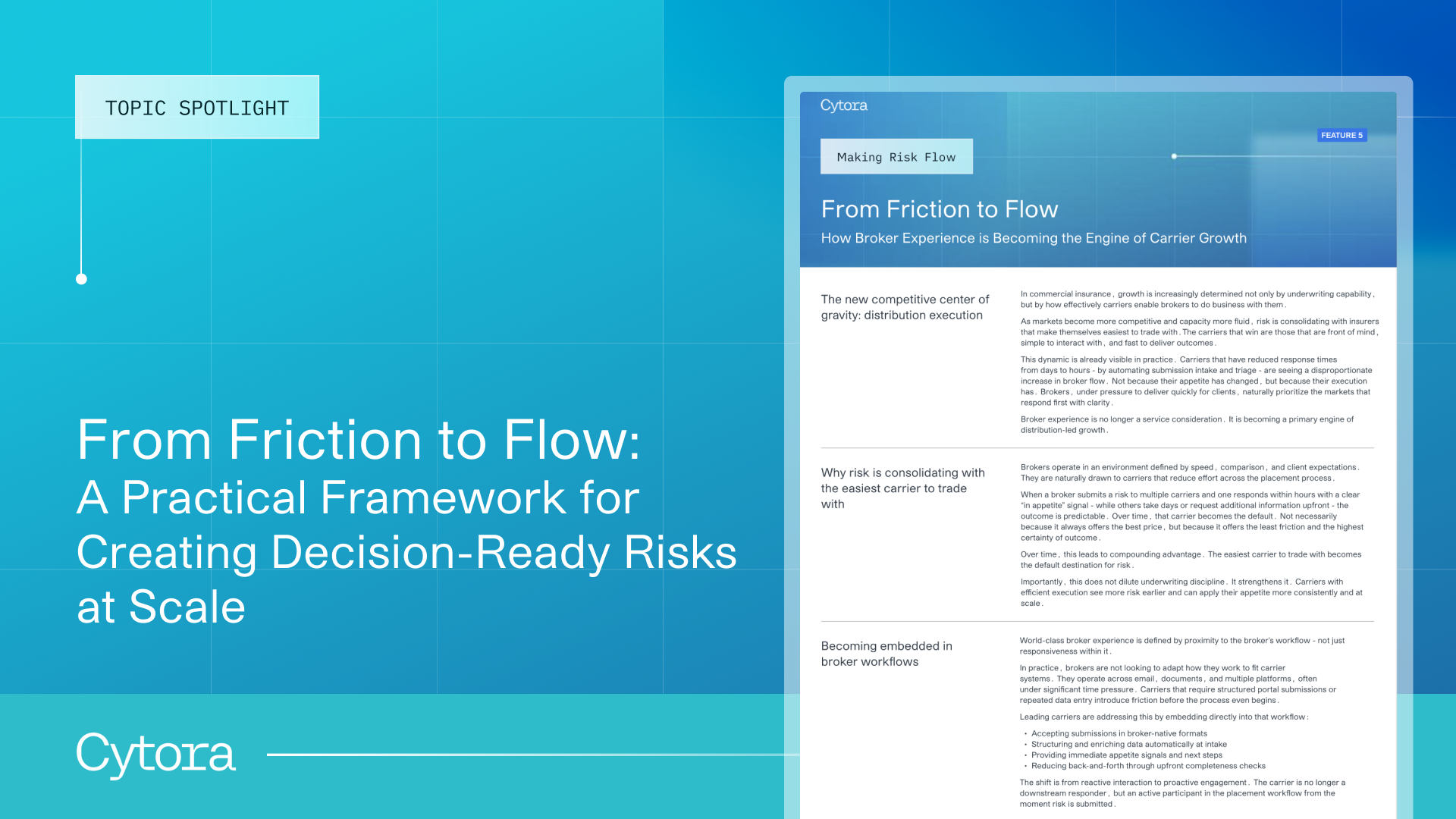
In commercial insurance, growth increasingly depends not just on underwriting capability, but on how easy carriers are to do business with. As capacity becomes more fluid, risk is consolidating with insurers that reduce friction and deliver outcomes fastest.
Carriers that have cut response times from days to hours are seeing a disproportionate rise in broker flow — not because their appetite changed, but because their execution did.
Why Risk Consolidates with the Easiest Carrier to Trade With
Brokers naturally gravitate toward carriers that reduce effort across the placement process. When one carrier responds within hours with a clear appetite signal — while others take days — that carrier becomes the default. Over time, this creates compounding advantage: the easiest carrier to trade with becomes the destination of choice for risk, without diluting underwriting discipline.
Becoming Embedded in Broker Workflows
World-class broker experience means meeting brokers where they already work — email, documents, multiple platforms — rather than forcing them into rigid portals. Leading carriers are embedding directly into broker workflows by accepting broker-native submission formats, structuring and enriching data automatically, and providing immediate appetite signals.
Defining the Path of Least Resistance
Friction accumulates in predictable places: incomplete submissions, manual rekeying, triage delays, unclear appetite feedback, and repetitive information requests. The most effective carriers automate every step that can be automated — creating continuity of flow instead of stop-start processing.
Speed as a Distribution Multiplier
Speed only matters when it produces outcomes brokers can act on immediately. Carriers improving speed across the entire lifecycle — from intake to underwriting allocation — can route low-complexity risks straight through to a quote in minutes, while more complex risks are enriched and prioritized before reaching an underwriter.
Connectivity and Data: The Foundation of Modern Broker Experience
Seamless broker experience depends on high-quality data exchange. Carriers are moving from fragmented, manual data handling — emails, PDFs, spreadsheets — to structured connectivity that transforms unstructured inputs into clean, usable data at the point of intake.
AI and Automation: From Passive Workflows to Active Execution
AI is shifting underwriting and distribution from static processing to dynamic execution — interpreting submissions, flagging missing information, prioritizing risk, and continuously updating submissions as new data arrives. This moves carriers from reactive response to agentic, always-on execution.
Maintaining Underwriting Integrity While Simplifying Experience
Reducing friction doesn't mean compromising underwriting quality. By embedding appetite and decision criteria directly into workflows, carriers ensure every risk is evaluated consistently — improving efficiency while reinforcing underwriting discipline at scale.
What a World-Class Broker Experience Looks Like
The broker experience of the future is defined by immediacy, transparency, and continuity — where brokers get instant appetite confirmation, automatic data validation, and clear next steps, often without manual intervention.
Recommendations for Carriers
- Redesign submission intake to eliminate manual effort at the source
- Embed appetite and triage logic directly into workflows
- Invest in structured data exchange with brokers
- Automate routine decisioning steps to accelerate cycle time
- Use AI to move from passive processing to active, continuous execution
Broker experience is becoming a structural growth lever. The carriers that win won't just respond faster — they'll remove friction entirely.
Download
From Friction to Flow How Broker Experience Is Becoming the Engine of Carrier Growth


Get the latest from Making Risk Flow

