


The Deployment Framework for Going Headless
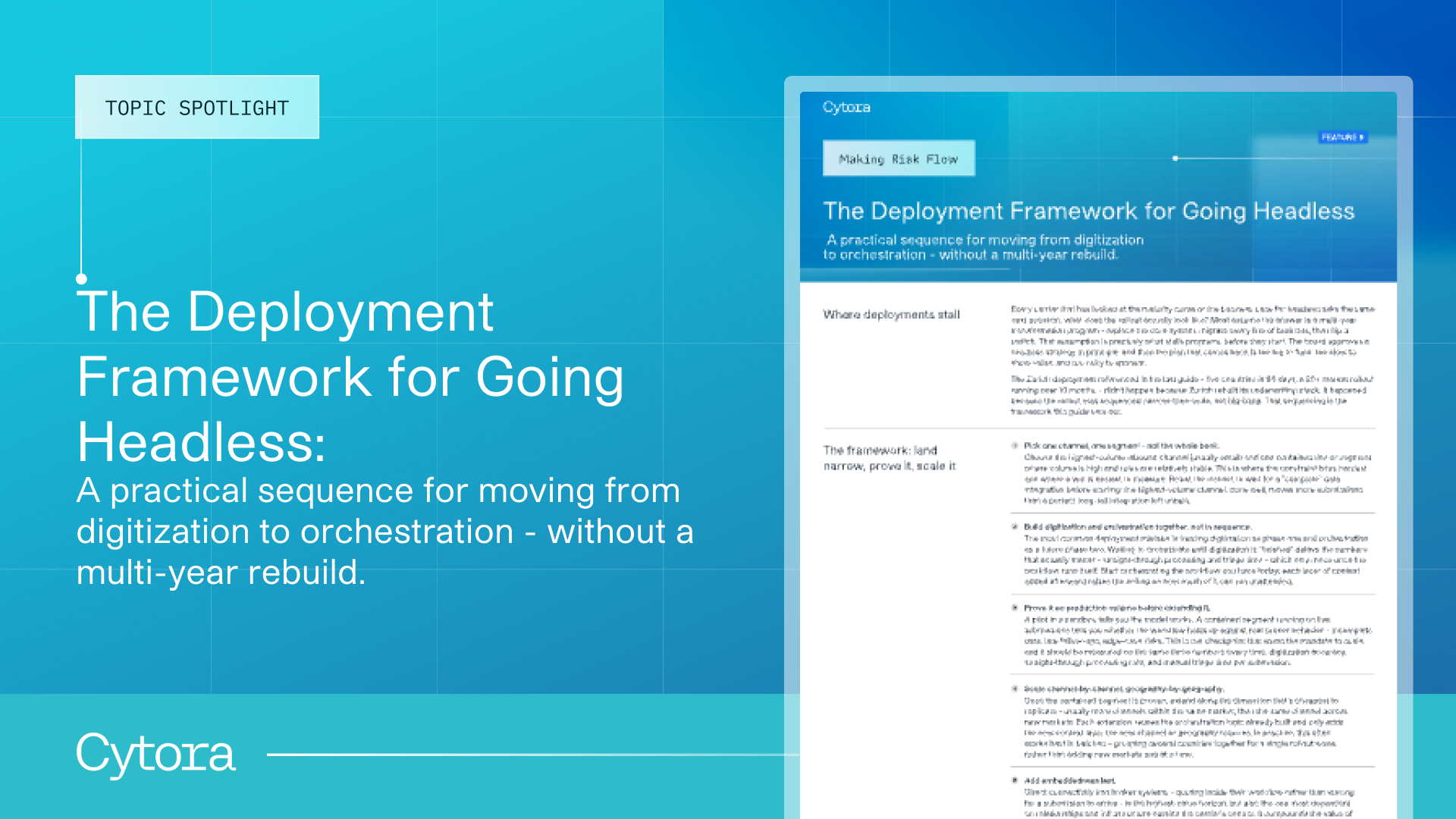
Most carriers agree that headless underwriting is where the market is heading. The harder question is what the rollout actually looks like.
For many teams, the answer seems to be a sweeping transformation program: replace the core system, migrate every line of business, then switch everything over at once. That assumption is often what stops programs before they start. Plans come back too big to fund, too slow to show value, and too risky for anyone to sponsor.
There's a better way to sequence it.
Land narrow, prove it, then scale
The carriers making real progress on headless aren't the ones with the most complete transformation plans. They're the ones that run the smallest deployment that can prove the number that matters, then repeat it.
That means starting with a single high-volume channel and one contained segment, and running digitization and orchestration together instead of one after the other. From there, you prove results on live production volume before expanding by channel and geography. Each wave reuses what was already built, so every rollout moves faster than the one before.
What this looks like in practice
Zurich used this narrow-then-wide approach to go live in five countries in 90 days, as part of a 20+ market rollout over 16 months. The results went well beyond better data extraction:
- Straight-through processing rose from 10% to 95%
- Manual triage time fell 80%, from 75 minutes to 15 minutes per submission
- Digitization accuracy improved from 70–80% to 98%
Better extraction alone doesn't produce those STP and triage gains. They came from orchestrating the workflow early in the rollout, rather than waiting for digitization to be "finished."
What's inside the guide
This guide sets out the five-step deployment framework in full, including:
- How to choose the right first channel and segment
- Why treating orchestration as "phase two" is the most common deployment mistake
- The three metrics to track at every checkpoint, and which one to lead with when reporting to sponsors
- How to batch geographic expansion so each wave scales faster
- Where broker embeddedness fits, and why it should come last
- The warning signs that a narrow-then-wide rollout is turning into narrow-then-stuck
Download the Deployment Framework for Going Headless
Get the practical sequence for moving from digitization to orchestration, and see how to show value within a single quarter.
Download
The Deployment Framework for Going Headless


Get the latest from Making Risk Flow

