


The Format of a Decision-Ready Risk A Practical Framework for Creating Decision-Ready Risk at Scale
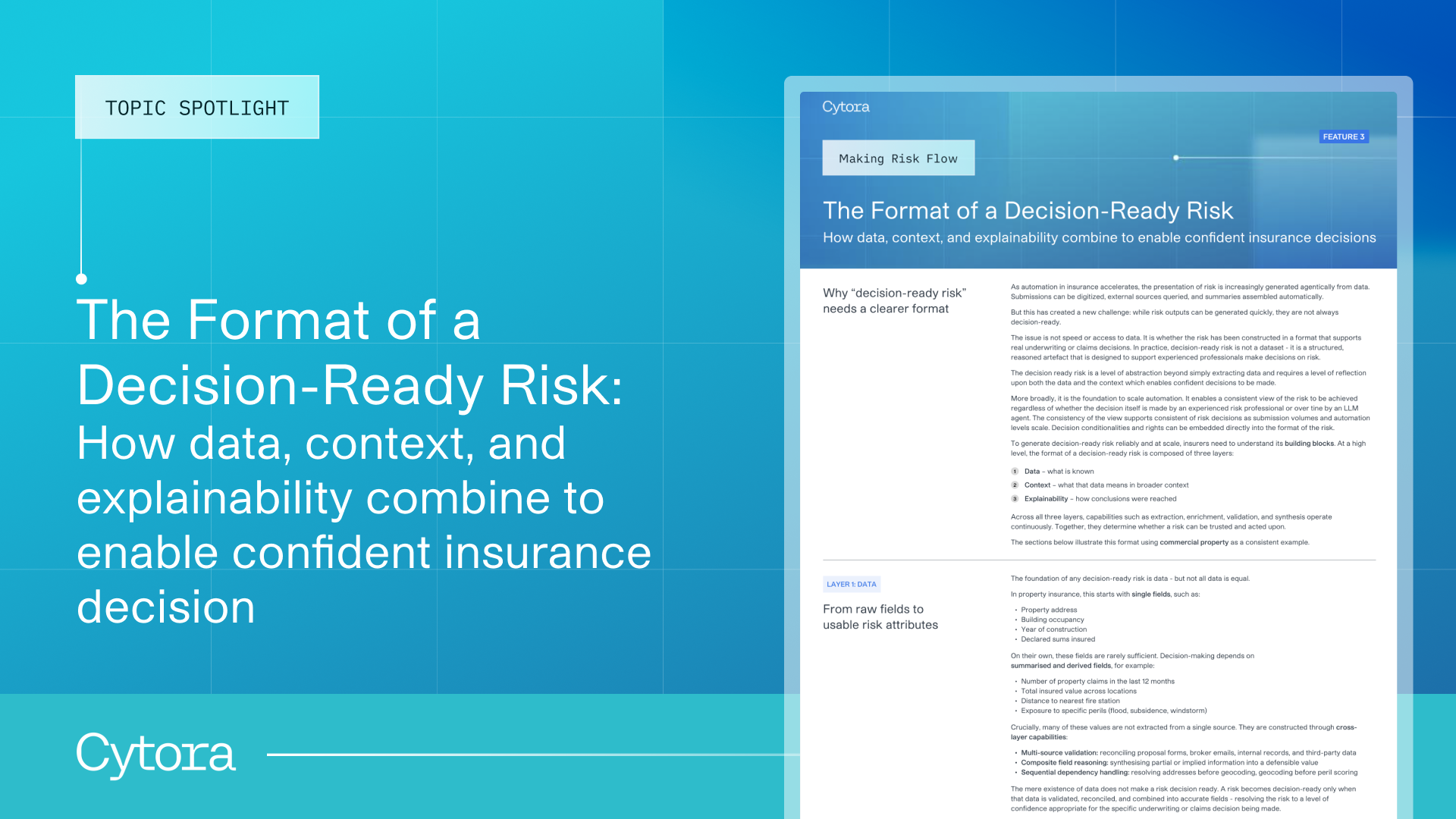
Insurers can now generate risk data faster than ever. Submissions are digitized, external sources queried, and summaries assembled automatically. But faster risk digitization doesn't automatically mean better underwriting decisions.
The real challenge isn't speed — it's whether risk data is structured in a way that supports confident, consistent underwriting and claims decisions. That's what separates raw data from decision-ready risk.
The 3-Layer Framework for Decision-Ready Risk
This guide breaks down the format insurers need to scale risk decisioning with confidence:
Data — How to move beyond raw fields to validated, reconciled risk attributes that reflect real-world underwriting needs.
Context — How to situate a risk within its broader picture: portfolio exposure, comparable risks, and lifecycle stage.
Explainability — How to make underwriting reasoning transparent, reviewable, and trustworthy — for both human underwriters and AI-driven decisioning.
Why Decision-Ready Risk Matters for Insurance Automation
As agentic AI and automation reshape commercial insurance, the insurers who win won't be the ones generating risk outputs fastest. They'll be the ones who control the format of decision-ready risk — enabling consistent, scalable decisions across underwriting and claims, whether made by an experienced professional or an AI agent.
Using a commercial property example, this guide shows exactly how leading insurers are building this framework into their risk digitization strategy today.
Download the Guide: The Format of a Decision-Ready Risk
Get the full framework for scaling confident insurance decisions.
Download
The Format of a Decision-Ready Risk A Practical Framework for Creating Decision-Ready Risk at Scale


Get the latest from Making Risk Flow

