


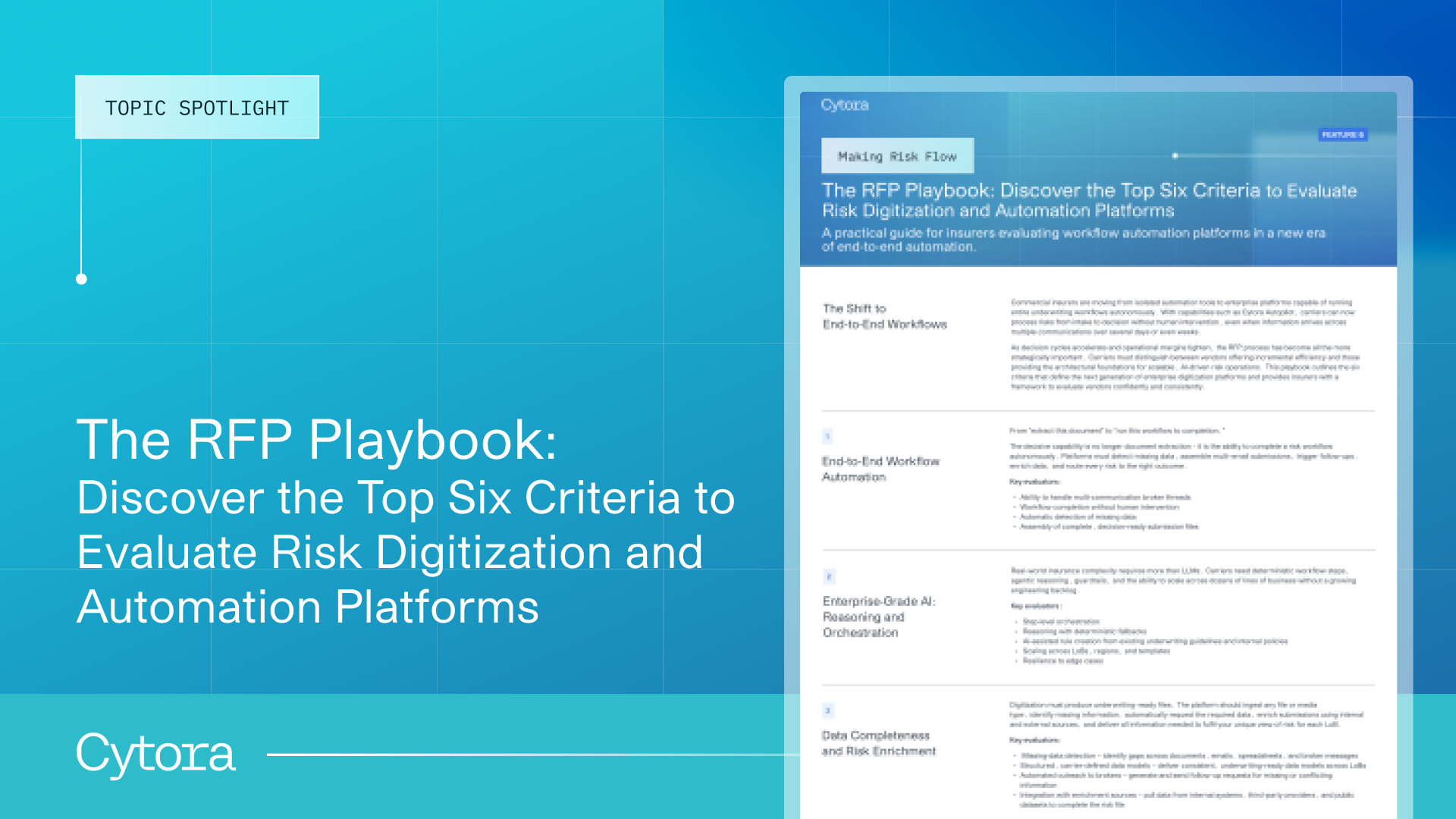
The RFP Playbook Discover the Top Six Criteria to Evaluate Risk Digitization and Automation Platforms
Commercial insurers are moving from isolated automation tools to enterprise platforms capable of running entire underwriting workflows autonomously — processing risks from intake to decision without human intervention, even across multi-day, multi-communication submissions.
As decision cycles accelerate, the RFP process has become strategically critical. Carriers must distinguish between vendors offering incremental efficiency and those providing the architecture for scalable, AI-driven risk operations. This playbook outlines the six criteria that define next-generation digitization platforms — plus a full 60-question RFP template.
1. End-to-End Workflow Automation
The decisive capability is no longer document extraction — it's completing a risk workflow autonomously. Evaluate whether a platform can handle multi-communication broker threads, detect missing data, and assemble complete, decision-ready submission files without human intervention.
2. Enterprise-Grade AI: Reasoning and Orchestration
Real-world insurance complexity requires more than LLMs alone. Look for deterministic workflow steps, agentic reasoning, governance guardrails, and the ability to scale across dozens of lines of business without a growing engineering backlog.
3. Data Completeness and Risk Enrichment
Digitization must produce underwriting-ready files. Key evaluators include missing-data detection, structured carrier-defined data models, automated broker outreach for missing information, and integration with internal and third-party enrichment sources.
4. Agentic Decisioning & Insight
Modern underwriting automation goes beyond static appetite rules. Next-generation platforms should dynamically interpret guidelines, trigger specialized skills like exposure analysis and sanctions checks, and route or decide with underwriter-level nuance — backed by governance controls and continuous learning from outcomes and overrides.
5. Explainability, Auditability, and Governance
Trust in automation depends on visibility. Every extraction, enrichment, and decision needs a transparent, step-by-step reasoning log, full audit trail, and human-in-the-loop override capability for regulators and underwriting leadership.
6. Time to Value and Total Cost of Ownership
The biggest hidden risk in digitization investments is underestimating the cost of scaling. Evaluate time to go-live, speed of configuring new lines of business, minimal engineering requirements, and continuous upgrades without customer-side rebuilds.
Why This RFP Framework Matters
The digitization platform insurers choose today will shape underwriting efficiency, cost structure, and competitive agility for the next decade. Forward-looking carriers are shifting from tactical automation to enterprise-grade, reasoning-driven workflow orchestration.
Download the Guide: The RFP Playbook
Get the full 60-question RFP questionnaire to evaluate risk digitization and automation vendors with confidence.
Download
The RFP Playbook Discover the Top Six Criteria to Evaluate Risk Digitization and Automation Platforms


Get the latest from Making Risk Flow

