


Why AI falls short in commercial insurance workflows

Most conversations about AI in commercial underwriting start in the wrong place. They start with a tool — a screen, an extraction model, a copilot — and ask how much time it saves. The more useful question is architectural: as AI moves through the underwriting workflow, what operating model does it leave behind, and where is that model heading?
That is what the maturity curve is for. It is not a feature roadmap. It is a way of framing the correct approach to meaningful AI implementation and of reading where a carrier sits today, being honest about the distance between digitizing documents and running risk workflows. Each step up the curve changes what the business can do, not just how fast it does the same thing.
Five stages, one direction of travel
The curve describes five stages. What matters is less the label on each step than the shift in agency between them.
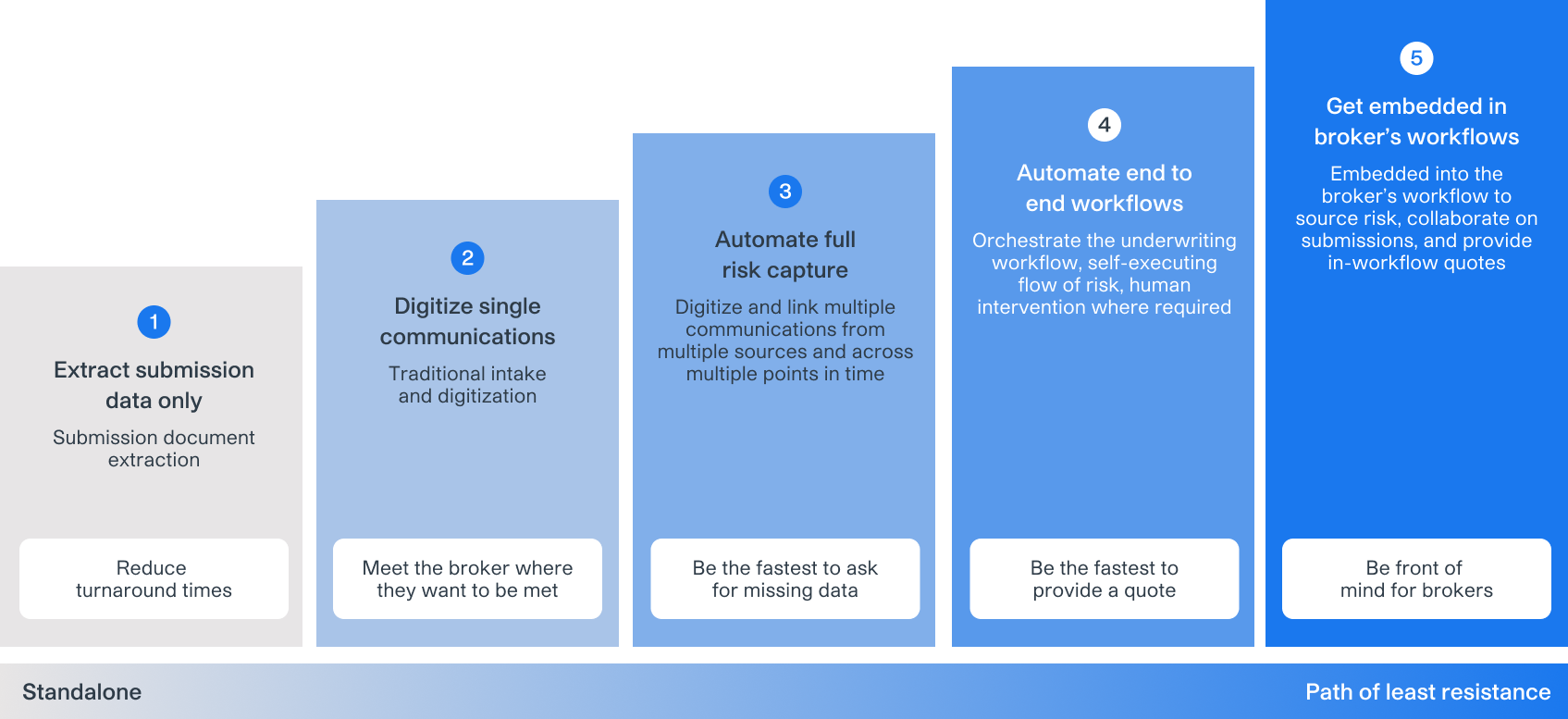
1. Extract submission data. The starting point for most carriers: pulling fields out of a submission document. This is where a wave of insurers landed in the last 5-10 years; with document-extraction tooling. It reduces turnaround times, and it is real work, but it is also now close to a commodity. Dropping a submission into a general-purpose model gets a surprisingly usable answer, which is precisely why extraction alone is no longer a moat.
2. Digitize single communications. A step up in sophistication: not just parsing one attachment, but enriching a single communication with external data, web research and summarization. The output is richer, but the unit of work is still a single transaction, handled in isolation.
3. Automate full risk capture. Here the model starts to behave less like a parser and more like a colleague. It digitizes and links multiple communications, from multiple sources, across multiple points in time — the broker email, the follow-up, the portal, the third-party feed — and assembles them into one coherent picture of the risk. The competitive prize at this stage is being the fastest to know what is missing and to ask for it.
4. Automate end-to-end workflows. This is the inflection point, and it is where the story stops being about data and starts being about orchestration. The platform doesn't just hold the data; it acts on it — moving a submission through appetite checks, invoking pricing tools and rating engines, chasing missing information — with a self-executing flow of risk and human intervention only where it is genuinely required. This is the difference between software that optimizes a person's clicks and software that carries the work itself.
5. Get embedded in the broker's workflow. The final stage in markets where it is achievable: the carrier is present inside the broker's own systems — sourcing risk, collaborating on submissions and returning in-workflow quotes. The goal is to be the path of least resistance, and therefore front of mind, whenever a broker has a risk to place.
The through-line is deliberate. Each stagehands more of the orchestration to the platform and reserves more of the human's time for judgment. Digitization is the foundation. Orchestration is the transformation.
Two curves, because the market isn't one market
The fifth stage does not travel equally everywhere. In the US, direct connectivity into broker management systems is often a genuine structural advantage — a large share of brokers sit on a small number of platforms, so “embedded in the broker's workflow” can be a realistic and powerful end state. In much of Europe and other regions, that connectivity tends to be more fragmented, and a version of the curve that leans too heavily on it may ring false.
So there are two readings of the same model. The embedded version runs the full five stages and treats broker connectivity as the summit. The region-agnostic version shifts the early stages along and tops out at end-to-end orchestration — document extraction, then enriched single-communication digitization, then automating and linking the back-and-forthwith the broker, then orchestrating the workflow end to end. The distribution advantage differs by geography; the operating-model transformation does not. Both versions describe the same fundamental journey from handling data to running workflows. Either way, connectivity across systems and datasources should be a key priority for any carrier approaching AI orchestration: the operating-model transformation depends on the platform's ability to link risk data end to end, wherever it originates.
Where the curve is pointing: from digitization to decisioning
The stages describe the path. They are worth reading alongside the destination, because the destination is what makes the climb worth it.
The industry has spent several years describing this category as risk digitization. That framing has done its job, but it undersells what the technology now does. Digitization implies unstructured-to-structured. A data play. A document problem. The frontier is not turning documents into fields. It is informing, and increasingly executing, decisions on the risk.
The near-term version of this keeps a human firmly in the loop: the platform digitizes the risk, evaluates it against the carrier's underwriting guidelines, and makes a recommendation – ‘this one sits outside appetite’, ‘this one is a clean straight-through quote’,‘this one should route to an underwriter’, and ‘here is the suggested approach’. Decision intelligence, in other words, with the expert making the call.
The further horizon is execution. Once a decision is clear, the platform acts on it — connecting to a rating engine to return a quote on a standard risk, or recognizing that a complex property submission needs a site visit and orchestrating that step before resuming the flow. Whether any given carrier wants that decision executed automatically or confirmed by a person is a choice, and it varies by segment: small commercial has been automating end-to-end for years, while mid-market and complex lines will keep a human in the loop for good reason.
This is where the role of the underwriter is elevated rather than threatened. The most compelling framing is the underwriter as the peer reviewer of AI — no longer executing every step, but reviewing and confirming what the platform proposes. Less clerical orchestration, more high-value judgment. That is a promotion, not a redundancy.
A note on screens
One objection surfaces in almost every carrier conversation: “but we need a UI.” It is a fair operational request, and it is also the least important part of this story. A serviceable interface onto digitized, orchestrated risk is straightforward to build. The digitization and orchestration underneath it are the hard, defensible part. The way underwriters and claims handlers interact with risk is going to change completely over the next few years, and any strategy that starts from the screen is optimizing the wrong layer. Build for the workflow; let the interface follow.
Where does your organization sit?
The value of the curve is diagnostic. Most carriers are further down it than their ambitions imply — comfortable at extraction, occasionally at single-communication digitization, and some distance from genuine end-to-end orchestration, let alone decisioning.
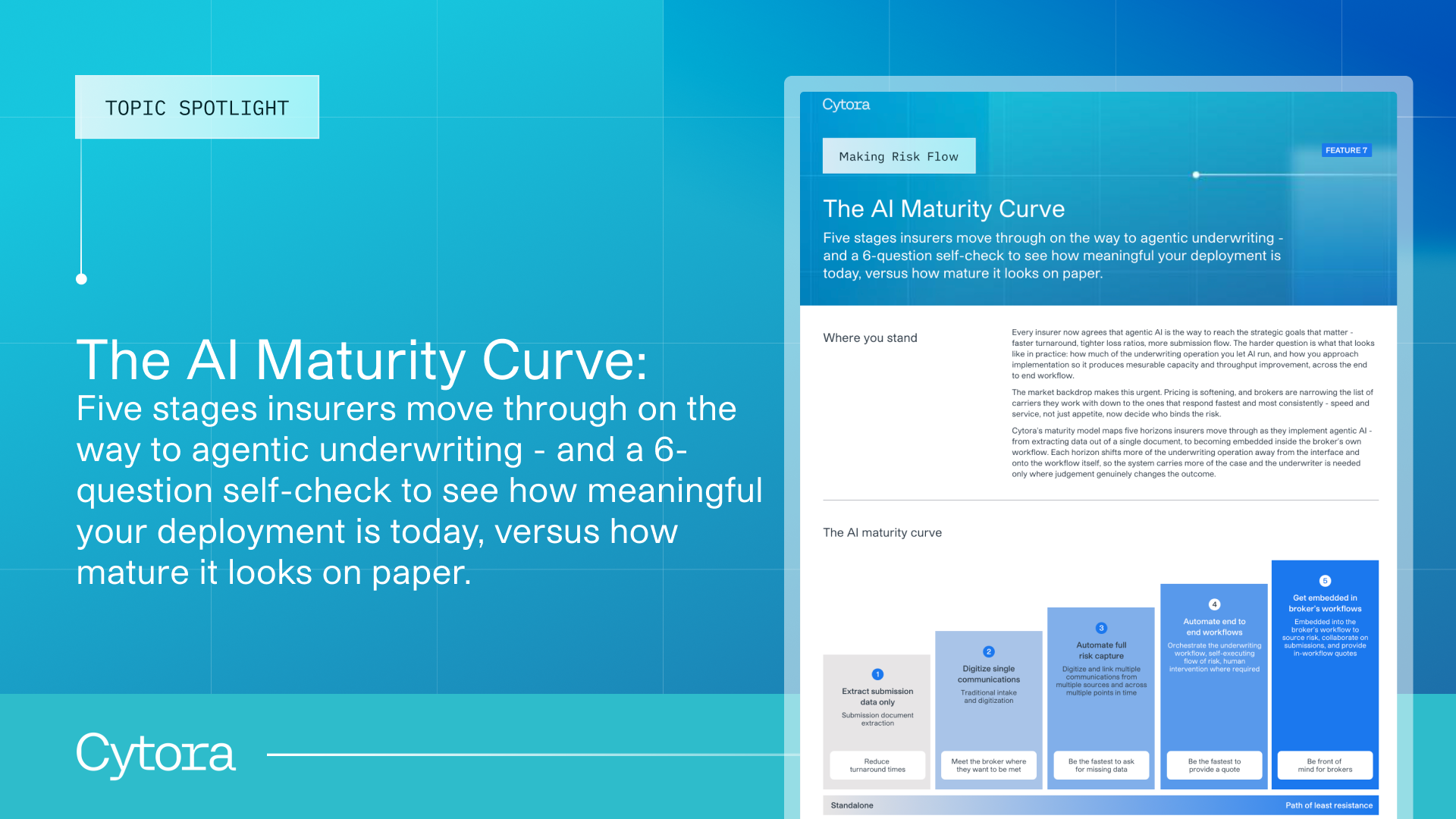
Knowing your current stage, and the specific gap to the next one, is the first practical step. We have built a short self-assessment to help underwriting and transformation leaders place their organization on the curve and identify the highest-value move from where they stand today.
Download the Guide: The AI Maturity Curve
Take the self-check and find out where your underwriting operation stands today.


Get the latest from Making Risk Flow

