


Why the future of commercial insurance is headless
The last article ended on a claim that reframes the whole underwriting stack: once orchestration is what moves risk, the model — not the interface — becomes the system of action, and digitization and orchestration are simply two behaviours of that one model. Accept that, and an architectural conclusion follows almost immediately. If the model is what trades the risk, then the interface carriers have spent years thinking about is no longer the thing the operating model should be built around. That concept is called headless.
From orchestration to headless: the logical next step
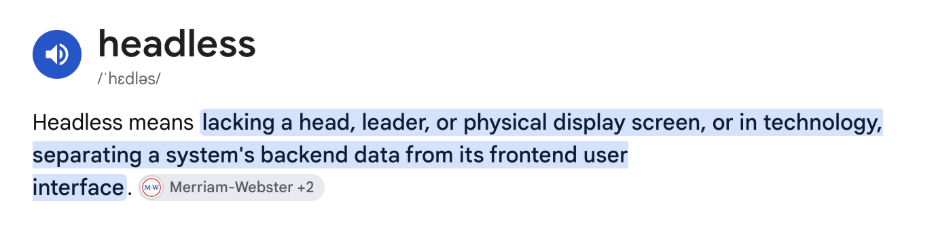
Headless means digitization and orchestration is decoupled from any single interface. The value and the defensibility live in the agentic models, the operational logic and the execution capability — the parts that read a risk, link it across time, test it against appetite and carry it to a quote. The interface becomes one consumer of that mechanism among several, not the place the work happens.
This is not an argument against interfaces. A carrier still needs somewhere for a human to exercise judgment, and we will come to what that surface should look like later in the series. The point is narrower and more consequential: the mechanism is no longer designed around the screen. When risk moved through a workbench, every capability had to be expressed as something a person clicked. When risk is moved by headless orchestration, capability becomes the remit of the orchestration mechanism, and the screen is free to become whatever best serves the human moments that remain. Building the operating model around the interface, at the exact moment the interface stops being what moves the work, is building around the wrong layer.
Software is losing its head
This is not an insurance-only observation. It is a shift running through enterprise software as a whole, and commercial insurance is a late but inevitable participant.
The venture firm a16z captured the dynamic in a piece titled “Is Software Losing Its Head?” Its argument: in the agentic era, the traditional SaaS moat — built on human muscle memory and interface familiarity — is eroding fast. Agents do not need dashboards. They need APIs, context, instructions and the ability to act. A product whose defensibility rested on underwriters knowing where every button was loses that defensibility the moment a mechanism, not a person, is driving the workflow.
Applied to underwriting, the implication is blunt. Buying a workbench today is a bet that humans will remain the orchestrators of risk workflows. Everything in this series so far argues that the mechanism is taking over that orchestration role. A bet on the human-as-orchestrator is therefore a bet against the direction the whole market is moving.
What headless changes for a carrier
None of this matters as architecture for its own sake. It matters because of what it changes in the operating model. The business case runs across three dimensions.
Growth decouples from expense. In a headless paradigm, submission or renewal processing capacity is not set by how many underwriters are logged into a screen. The mechanism can process ten thousand submissions during renewal season with the same latency as a single risk, scaling with demand rather than with hiring. That breaks the link between premium growth and operating expense — a carrier can grow its book without growing its underwriting team in proportion.
Speed and consistency become structural. In commercial and specialty markets, where pricing and coverage are broadly comparable, brokers direct business to the carriers that respond fastest and most reliably. Responding in minutes, not days, means the carrier is first to quote on the risks it wants — and applying the same appetite logic and enrichment to every submission, every time, removes the process variability that comes from individual judgment on routine tasks.
Channel friction disappears. The traditional submission path — brokers emailing PDFs, underwriters re-keying data, replies drafted by hand — builds latency into every step. Connecting directly into broker agency management systems through APIs, without any human handling the submission, lets risk data flow natively from the broker's system into the carrier's. The submission email disappears. The re-keying disappears. The carrier becomes structurally faster than any competitor still working from an inbox.
The proof it works at scale
The architecture is already in production, and the evidence comes from two directions: a carrier running the model, and the market rewarding those who do.
Travelers has deployed this model as what it describes as its upstream, headless intelligence layer — the mechanism that converts unstructured, multilingual submissions into structured, decision-ready risks aligned to its global underwriting standards. It went live across five countries in 90 days on a repeatable template, and is now extending the model to more than twenty markets over sixteen months. The significance is less any single metric than the shape of the rollout: a headless mechanism deploys and scales across markets in a way a screen-first workbench, rebuilt for each geography, does not.
The market data points the same way. McKinsey research finds that AI leaders in insurance have generated 6.1 times the total shareholder return of AI laggards over the past five years. Intact Financial has publicly reported $150 million in annualised returns from 500 deployed AI models — among the clearest ROI demonstrations in the industry. These are public, third-party figures rather than vendor claims, and they describe the same trajectory: the carriers treating AI as core architecture are pulling away from those treating it as a feature.
The broker's-eye view
Most efficiency arguments for automation are told from the carrier's side of the desk. The more interesting case is the broker's, because it connects headless architecture to revenue rather than only to cost.
In markets where price and coverage are broadly comparable, placement follows service: the broker predominantly sends the risk to whoever comes back first, cleanly, with a clear answer on appetite, decision and quote. A headless mechanism is what makes a carrier that destination — quoting in minutes, and, at the top of the maturity curve, quoting inside the broker's own system rather than over email. Straight-through processing rates for standard risks are already climbing into the 70–90% range for carriers that have moved past pilots into production. This is the mechanism behind the final stage of the maturity curve, embedding in the broker's workflow: it is only possible once the intelligence is headless and can be delivered wherever the broker already works.
Headless is a bet on where the market is going
Every architecture is a bet about the future. A workbench is a bet that humans will remain the orchestrators of the workflow, and that the interface is therefore where the value sits. Headless is the opposite bet: that the mechanism orchestrates, that the value lives in the models and logic beneath, and that the interface should serve the judgment that remains rather than define the operating model. The evidence — the technology shift, the production deployments, the market returns, the direction of broker preference — points one way.
Which raises the obvious question, and the subject of the next article. If the workflow is no longer built around the screen, what happens to the workbench itself? It does not vanish — but its role changes fundamentally, from running the work to overseeing it. That is where we go next.


Get the latest from Making Risk Flow

